Rediscovering Calm
• Written by Lorenzo Vainigli

This project, which I have decided to call Zen Puzzle, arose from the convergence of several ideas that, at a certain point, came together to form a single concept. On the one hand, there was a desire to create an experience capable of slowing down the usual pace at which we use apps, making room for something calmer, more contemplative and less influenced by artificial urgency. On the other hand, there was a very simple yet, for me, important insight: a jigsaw puzzle does not necessarily have to be an isolated pastime, tied to a single image and destined to be completed in a matter of minutes. Instead, it can become part of a collection, a small series of images to be conquered and preserved over time. Ultimately, Zen Puzzle stems precisely from this balance: relaxing, building something calmly and valuing what is completed.
Where the Idea Came From
The idea for this app came from my desire to solve a few puzzles, but I wasn’t interested in treating it as a one-off experience tied to a single image. Instead, I liked the idea of being able to return to the same space several times, discovering different images, completing them at my own pace and watching a small personal collection grow over time. From there, a clearer idea began to take shape: perhaps the feeling I was looking for didn’t exist exactly as I imagined it, and so it was worth trying to create it.
Subtracting Rather Than Adding
Many of the features we now take for granted in apps and games (timers, leaderboards, constant rewards, and more or less explicit pressure to return or carry on) weren’t really necessary for the experience I wanted to create. The interesting thing is that, once all these ‘distractions’ are removed, the very way you experience the game changes, because you’re in no hurry, there’s nothing forcing you to keep going, and you can simply stay there, facing the image you need to reconstruct.
Reaching the Image
Another aspect that struck me as important was avoiding instant gratification. We’re used to seeing everything straight away, to scrolling, to moving on with an almost automatic speed. In Zen Puzzle, however, the image isn’t immediately visible. It’s hidden, and you have to work your way towards it piece by piece. Only at the end does it reveal itself fully, along with a brief description that provides a little context. It is not a long or encyclopaedic explanation, but a curiosity, a detail that accompanies the discovery and makes that image less instantaneous, less ‘disposable’. At that moment, you haven’t simply seen something: you’ve arrived at it, and this changes your relationship with what lies before you.
The Zen Atmosphere
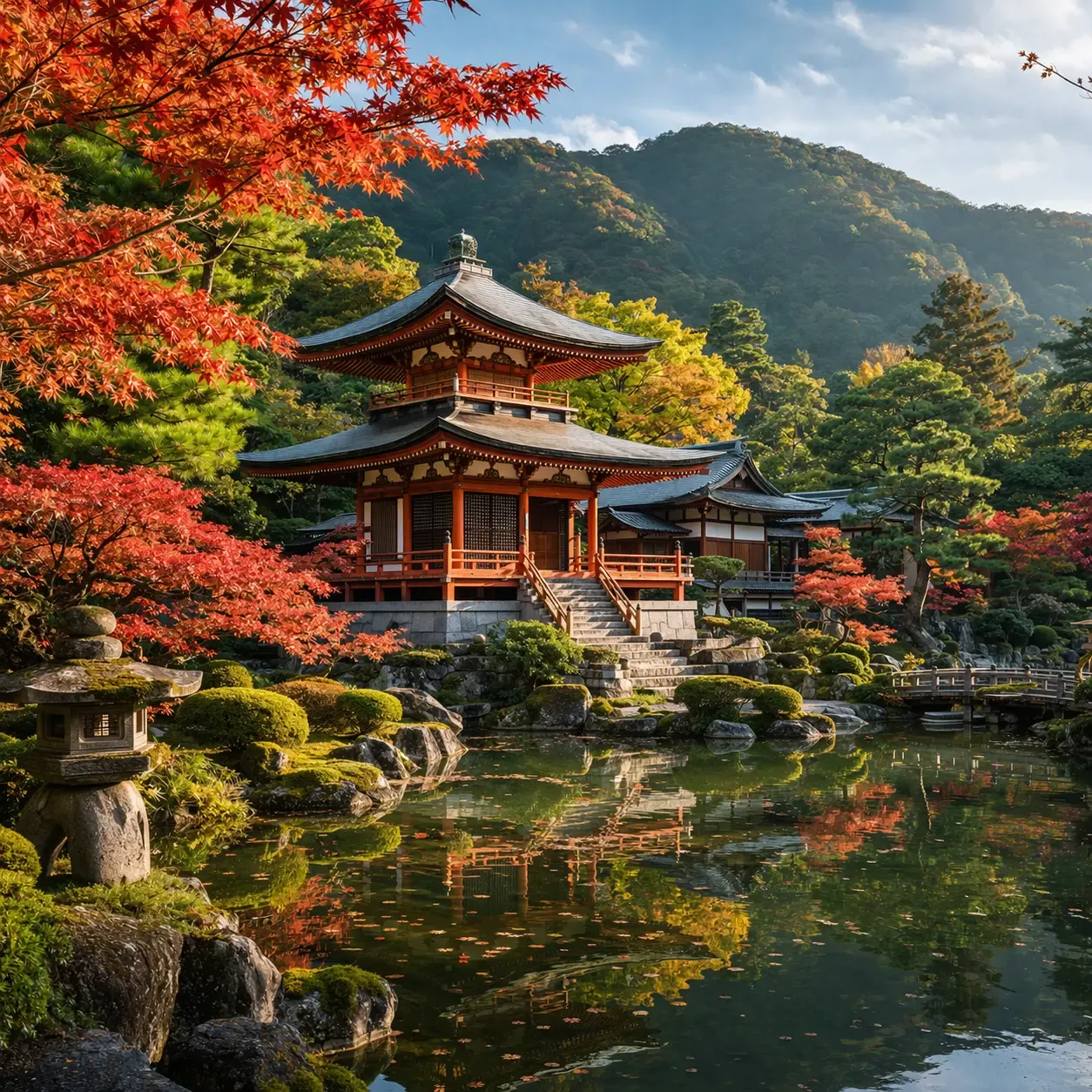
The choice of images also follows this concept. I opted for scenes inspired by Japanese aesthetics, not so much for purely thematic reasons, but because I have always found a certain balance there between simplicity, silence and attention to detail. Temples nestled in greenery, blossoming branches, minimalist landscapes, glimpses that do not seek to impose themselves but which, when observed calmly, still manage to convey something. This is precisely what interested me: images that work best in a slow-paced context, without being consumed in a matter of seconds.
The Joy of Collecting
There is also another aspect that means a great deal to me, one rooted in something I’ve carried with me since I was a child: the pleasure of collecting. In this case, it’s not about cards in the traditional sense, but the underlying idea is very much in line with that world. I liked the idea that people could not only solve a puzzle, but also keep it in a collection, watching a small collection of images grow over time, acquired calmly, one after the other. Looking back on it today, I realise that collecting has a special power, because it manages to give value to objects without necessarily making them complicated. And that is precisely what I find interesting: here we are talking about puzzles, that is, simple objects that can nevertheless become memorable precisely because they become part of a personal collection.
This aspect fits well with the other core element of the project. On the one hand, there is the idea of relaxation, of time given to the user and the freedom to stop whenever they wish. On the other, there is the pleasure of seeing a collection grow, of feeling that every completed puzzle does not vanish into thin air but remains there, like a tile added to a larger journey.
A Different Pace
The app’s pace is also designed with this in mind. There’s no rush, and there’s no sense of having to progress at all costs. You complete a puzzle, then perhaps move on to the next one – which might be slightly more complex – but without this progression becoming a source of pressure. If you stop, you stop. If you come back later, you pick up where you left off. I like the idea that the puzzle, at the end of the day, is almost an excuse to create a space where time moves a little differently from what we’re used to on our phones.
Staying Present
I think the most interesting part is exactly what happens whilst you’re playing. You have to watch carefully, try, make mistakes, try again, and you can’t really delegate anything or rush the process. In this sense, the puzzle forces you to stay present, and without even realising it, you slow down. It’s a very simple thing, but also quite rare in today’s digital world, where almost everything is designed to push you to take the next step as quickly as possible.
The Purpose of the Project
I don’t yet know exactly how big Zen Puzzle will become over time, but in truth, that isn’t even what interests me most. What I’d like to create is a space that’s different from what we’re used to, however small it may be, and to see if an experience that doesn’t constantly demand speed and responsiveness can still exist within a smartphone or tablet.
And if, by using the app, someone actually manages to take ten minutes for themselves without being dragged off elsewhere, then for me this project has already found its purpose.